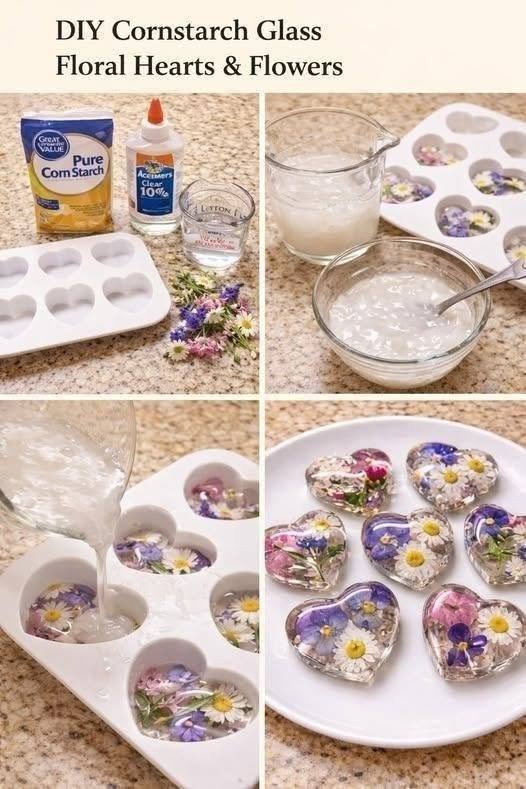
These translucent hearts and flowers catch the light like genuine stained or sea glass. Crafted from cornstarch, baking soda, water, and food coloring, this clay dough produces a smooth, frosted finish as it dries. These ornaments are ideal for displaying in sunlit windows, hanging as holiday accents, or stringing into decorative garlands.
Equipment & Ingredients
Component Breakdown
| Section | Ingredient / Tool | Quantity / Type | Functional & Craft Role |
| Ceramic-Mimic Base | Cornstarch | 1 cup | Primary structural starch base delivering a fine, smooth surface. |
| Baking soda | 1 cup | Moderates dough elasticity, prevents cracking, and adds a frosted-glass look. | |
| Filtered water | ¾ cup | Hydration medium required for thermal starch gelatinization. | |
| Finishing Essentials | Food coloring | Gel or liquid drops | Soft pastel tinting (light pastel colors maximize light diffusion). |
| Cookie cutters | Hearts / Flowers | Geometric and floral shaping. | |
| Parchment paper | 2 large sheets | Non-stick surface for rolling and drying dough. | |
| Perforation tool | Straw or toothpick | Cleanly punches hanging holes before the surface sets. | |
| Sealant (optional) | Mod Podge / Acrylic spray | Protects the finished starch matrix from ambient atmospheric humidity. |
🧪 Science of Starch Gelatinization & Light Diffusion
-
Thermal Starch Gelatinization: Raw cornstarch consists of tightly packed crystalline starch granules. Heating the hydrated slurry to $144^\circ\text{F}\text{–}158^\circ\text{F}$ ($62^\circ\text{C}\text{–}70^\circ\text{C}$) causes starch granules to absorb water and swell until they burst. This releases amylose and amylopectin molecules into a continuous polymer network—a thick, pliable hydrogel dough.
-
The Frosted-Glass Optical Effect: As the sculpted dough air-dries over 24 to 48 hours, water completely evaporates. The starch and fine sodium bicarbonate (baking soda) molecules pack together into a dense, uniform matrix. Because this solid matrix allows light waves to pass through in a diffused state rather than reflecting them, it mimics the appearance of frosted sea glass.
-
The ¼-Inch Thickness Rule: Keeping rolled dough at a precise ¼-inch thickness ensures proper light transmission while preventing structural warping or cracking during evaporation.
Step-by-Step Instructions:
LOOK NEXT PAGE DEAR──►
For Complete Cooking STEPS Please Head On Over To Next Page Or Open button (>)
For Complete Cooking STEPS Please Head On Over To Next Page Or Open button (>)