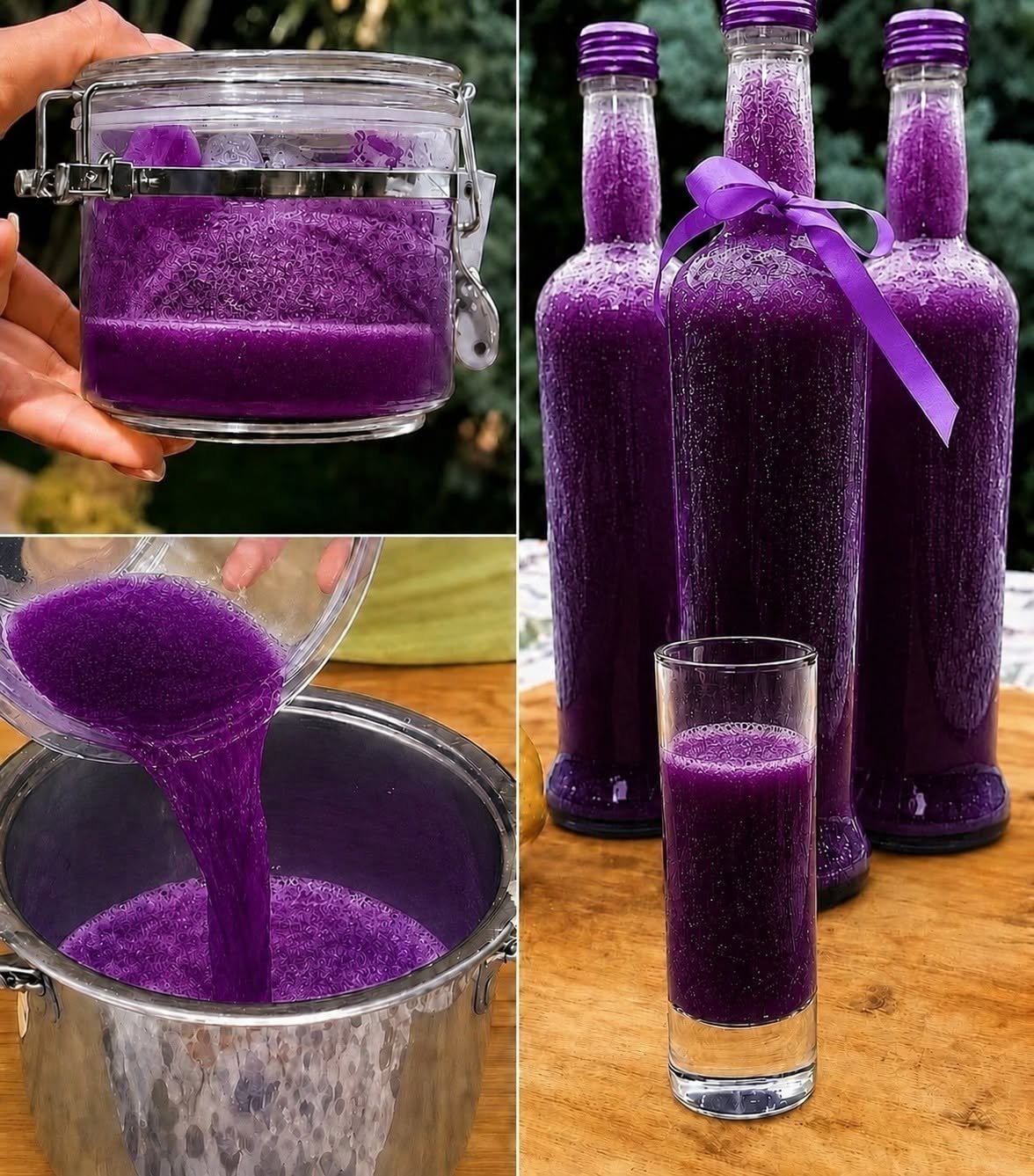
This Homemade Blueberry Juice highlights the sweet, woody flavor of fresh or frozen blueberries. Using a gentle heat-extraction method, it breaks down the fruit skins to yield a velvety, royal-purple juice that can be enjoyed chilled on its own, paired with breakfast, or mixed with sparkling water for a refreshing mocktail.
Equipment & Ingredients
Component Breakdown
| Section | Ingredient | Quantity | Culinary & Functional Role |
| Berry Base | Fresh or frozen blueberries | 4 cups (~600g) | Primary flavor, natural fruit sugars, and royal-purple pigment source. |
| Liquid Medium | Water | 1.5 cups (360ml) | Liquid carrier for extraction and sugar dissolution. |
| Sweetener | Granulated sugar | ⅓ cup (65g) | Balances natural fruit tartness (adjust to taste or substitute honey/maple syrup). |
| Acidifier | Fresh lemon juice | 1 tbsp (15ml) | Essential citrus acid that brightens flavor and stabilizes pigment. |
🧪 Food Science: Heat Extraction & Chromophore Brightening
-
Thermal Skin Breakdown: Simmering blueberries at $190^\circ\text{F}\text{–}200^\circ\text{F}$ ($88^\circ\text{C}\text{–}93^\circ\text{C}$) softens tough plant epidermal cells. This releases concentrated water-soluble anthocyanins (malvidin-3-glucoside) into the water without scorching volatile berry aromas.
-
Citric Acid Color Stabilization: Blueberries contain natural pigments that can appear dull or purplish-gray at neutral pH levels. Adding fresh lemon juice lowers the pH matrix, structurally shifting anthocyanins into their vibrant, red-purple flavylium cation state for an intense royal-purple hue.
-
Clarification Mechanics: Passing the warm juice through a fine-mesh sieve or cheesecloth removes seed fragments and tough skin fibers (insoluble cellulose), leaving a silky, uniform juice that doesn’t separate when chilled.
Step-by-Step Instructions:
LOOK NEXT PAGE DEAR──►
For Complete Cooking STEPS Please Head On Over To Next Page Or Open button (>)
For Complete Cooking STEPS Please Head On Over To Next Page Or Open button (>)
Sugar Free Condensed Milk 3 Ingredients

Wrap potatoes in tin foil and put in crock pot. Enjoy this lip-smacking result

Million Dollar Cream Cheese Pound Cake

Caramel Cream Cake

11 best smelling houseplants to make your home smell amazing